
Little May Gold Project
High-Grade Surface Discovery Report
Yavapai County, Arizona
Prepared for Junior Mining Review
Little May Gold Group — Bradshaw Mountains, Arizona
Private Exploration and Development Project
Owner / Developer: Eric Schultz, Schultz Resource Management, PLLC
Website: https://LittleMayGold.com
Land Position: 67 acres Arizona State Land mineral lease control + one 20-acre federal mining claim
Commodity Focus: Gold, silver, associated sulfides
Recent Assay Highlight: 48 g/t Au from recent surface sampling
Additional Recent Results: 3 to 21 g/t Au across professional assays
Silver Target: Approximately 4 oz/t Ag with free-milling gold presence
Gold Price Context: Approximately $4,500/oz Au
 The Little May Gold Project is an emerging high-grade gold and silver opportunity located in the western foothills of the Bradshaw Mountains near the Hassayampa River in Yavapai County, Arizona.
The project sits within a historically productive mineral corridor between the Octave and Congress mining districts, both known for significant historical gold production. Unlike many early-stage exploration projects that require substantial drilling before meaningful mineralized material can be evaluated, Little May presents exposed mineralized structures and stacked ore at surface.
The standout modern result is a recent professional assay returning approximately 48 grams gold per ton from surface-derived material. In junior mining terms, 48 g/t gold is high-grade by any standard. What makes the result more interesting is the setting: this is not a deep drill intercept requiring major capital to access. It comes from a project where multiple vein targets are already exposed at surface and accessible through practical field development.
Current verified field observations include eight surface vein targets ranging from approximately 6 inches to 48 inches in thickness. Recent professional assays have returned values from approximately 3 to 21 g/t gold, now strengthened by the 48 g/t gold result. A separate higher-grade silver vein has also returned approximately 4 ounces silver per ton and shows a strong presence of free-milling gold.
Historical reports from the property describe free-milling gold in quartz, sulfide presence, hematite, limonite, galena, silver, and associated mineralization. Historical bulk samples reportedly returned approximately 0.5 oz/t Au from the westerly zone and approximately 1 oz/t Au from the easterly zone. Earlier historical sampling reportedly ranged from 0.01 oz/t to 2 oz/t Au across approximately 24 sample locations.
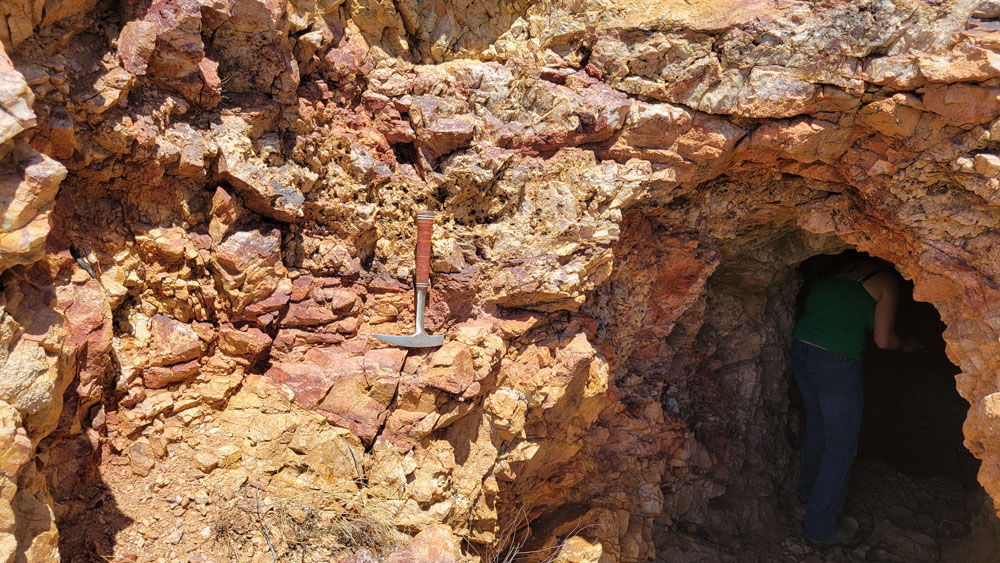
The geological setting includes limonite and hematite quartz vein mineralization associated with Bradshaw Granite, monzonite porphyry, rhyolite dikes, and diabase intrusions. The working interpretation is a structurally controlled vein system with multiple surface expressions, potential vertical continuity, and possible district-scale relevance given its location between known historical producers.
Why this matters:
The Little May Gold Project combines several elements junior mining reviewers look for:
• High-grade gold values, including a recent 48 g/t Au assay
• Multiple verified surface vein targets
• Surface-accessible mineralized material
• Historical bulk sample support
• Gold and silver mineralization in the same system
• Location within a proven Arizona mining district
• Low-overhead development potential
• Clear next steps for sampling, mapping, shallow drilling, and bulk exploration
At gold prices near $4,500 per ounce, near-surface high-grade material becomes increasingly significant. A 48 g/t gold sample is not a resource, and it does not by itself define an ore body. But in the context of exposed vein structures, historical reports, stacked mineralized material, and multiple modern assays, it becomes a serious exploration signal that deserves further technical review.
The immediate development thesis is straightforward: continue mapping, sampling, and structural interpretation; evaluate the exposed vein targets; test shallow continuity using portable core drilling; and advance low-impact bulk exploration where permitted.
Little May is not being presented as a completed mine or defined resource. It is being presented as a high-grade, surface-accessible exploration and development opportunity with historical support, modern assay confirmation, and a practical path toward the next phase of technical validation.
Additional materials available for qualified parties include:
• Historical reports
• Assay documentation
• Field photography
• GPS-referenced sample notes
• Vein target documentation
• Phase 2 discovery report
• Development and partnership overview
Serious junior mining groups, geological reviewers, strategic partners, and acquisition-minded operators are invited to review the project further.
Eric Schultz
Schultz Resource Management, PLLC
Little May Gold Project
https://LittleMayGold.com
Informational disclaimer:
This document is provided for informational and discussion purposes only. It does not constitute an offer to sell or a solicitation of an offer to buy securities or investment products.
Any participation in the Little May Gold Project will be structured in compliance with applicable laws and regulations and, where applicable, limited to qualified or accredited parties capable of evaluating the risks associated with mineral exploration and development.
Mineral exploration is inherently speculative and involves substantial risk. Recipients are encouraged to conduct independent due diligence and consult with their own legal, technical, and financial advisors.