
OpenClaw Questions And Answers
Page Contents
- OpenClaw Questions And Answers
- ClawedPod Is The OpenClaw Set-up For People Who Just Want To Get In And Go!
- Most people are not trying to win a technical trophy. They are trying to save time. They are trying to think more clearly. They are trying to run their business with less friction. They are trying to feel organized instead of scattered.
- So I did what I always do when something matters to me. I went all in. I tested every variation of OpenClaw setup. I studied how to start OpenClaw cleanly. I walked through the start command processes. I examined how people were trying to launch it from laptops, remote environments, and different hosting options. I read the GitHub issues. I followed the Reddit threads. I broke things and rebuilt them.
- There was a time when using email required technical configuration that most households would have never tolerated. Imagine if that barrier had stayed in place. Most of us would have never adopted it. Someone had to make it usable for regular humans.
- Questions And Answers About Setting Up OpenClaw With ClawedPod:
- Frequently Asked Questions About OpenClaw
- About the Author Eric Schultz – WebSuite Media | Vibe Code Company
- ClawedPod Is The OpenClaw Set-up For People Who Just Want To Get In And Go!
ClawedPod Is The OpenClaw Set-up For People Who Just Want To Get In And Go!
I would not put ClawedPod.com in front of you if I did not genuinely believe it is one of the cleanest and hassle free solutions available right now for setting up and actually using OpenClaw in real life.
Over the past few weeks I have watched the same questions pop up everywhere. On OpenClaw Reddit threads. Under OpenClaw GitHub discussions. In private messages. In forums. In group chats.
What is the OpenClaw start command?
How do I start OpenClaw TUI?
Where do I even begin?
What are real OpenClaw use cases?
Is there a simple OpenClaw setup guide that does not require me to become an engineer?
These are not dumb questions. They are honest ones. I believe we should hand people the thing and not make them suffer in trying to figure it out and build it before they can enjoy the benefits.
 Most people are not trying to win a technical trophy. They are trying to save time. They are trying to think more clearly. They are trying to run their business with less friction. They are trying to feel organized instead of scattered.
OpenClaw is powerful. It introduces a structured way to run tasks, memory, and functions in a coordinated assistant framework. It is not just chatting. It is coordination. It is persistent help. It is the beginning of something that can quietly change your daily workflow.
But here is the part no one says out loud.
The OpenClaw GitHub page is exciting.
The OpenClaw Reddit threads are fascinating.
The start commands and TUI instructions are impressive.
And for many regular people, they are overwhelming.
You start reading about how to set up OpenClaw and suddenly you are learning about terminals, commands, hosting environments, configuration steps, and security considerations. You look up how to start OpenClaw TUI and realize you are already ten tabs deep and still not sure if you are doing it correctly. You see the OpenClaw start command and wonder if one typo is going to break the whole thing.
At that point most people quietly close the browser.
That is the tragedy.
Because the use cases are real.
Imagine having a persistent assistant that remembers your ongoing projects.
Imagine being able to offload repetitive thinking.
Imagine organizing your inbox in a way that feels calm instead of reactive.
Imagine planning your week and having an intelligent second brain that does not forget context.
Imagine tracking tasks across your business without juggling five disconnected tools.
That is what OpenClaw promises, but the problem has never been imagination. It has been execution.
So I did what I always do when something matters to me. I went all in. I tested every variation of OpenClaw setup. I studied how to start OpenClaw cleanly. I walked through the start command processes. I examined how people were trying to launch it from laptops, remote environments, and different hosting options. I read the GitHub issues. I followed the Reddit threads. I broke things and rebuilt them.
And I realized something important.
The missing piece is not more instructions. It is a finished path.
Most people do not want to master how to set up OpenClaw. They want to use OpenClaw.
There is a difference.
This is where I will be direct with you.
Yes, I built something around this. Yes, I created ClawedPod. And yes, I believe it is currently the best way for regular people to get from curiosity to capability without burning days or weeks in the middle.
Not because it is flashy.
Because it removes friction.
When you look at the surge of interest around OpenClaw setup and OpenClaw start command searches, what you are really seeing is hunger. People sense that agentic frameworks are the next layer of leverage. Just like email once was. Just like search engines were. Just like the small apps on our phones that we now take for granted.

There was a time when using email required technical configuration that most households would have never tolerated. Imagine if that barrier had stayed in place. Most of us would have never adopted it. Someone had to make it usable for regular humans.
That is the role I decided to step into here.
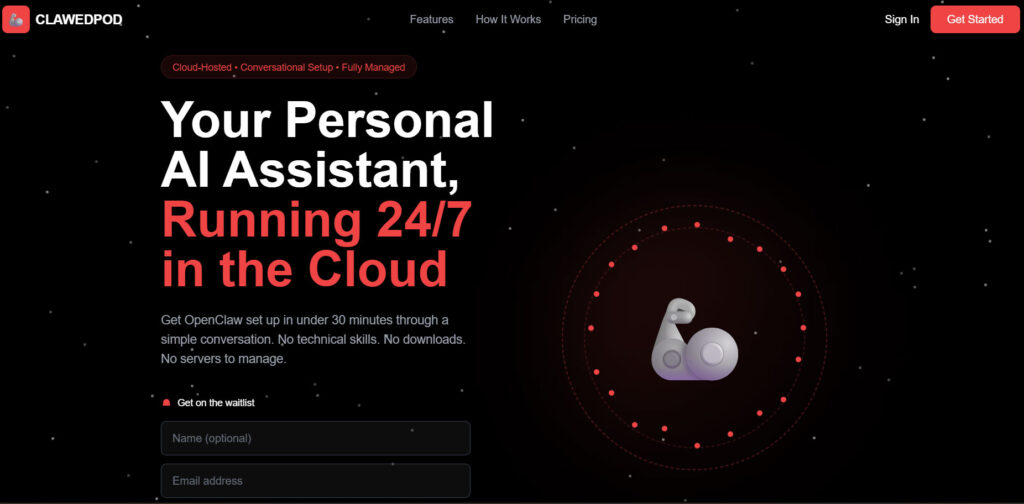
ClawedPod takes the OpenClaw framework and delivers it in a managed environment so you can focus on outcomes instead of commands. Instead of asking how to start OpenClaw TUI, you are already interacting with your assistant. Instead of wondering about the correct OpenClaw start command, you are assigning tasks. Instead of reading OpenClaw Reddit threads about troubleshooting, you are using the system the way it was meant to be used.
I say this carefully and responsibly.
This is not about hype. It is about participation.
The people who lean into this now are not trying to look smart. They are trying to move faster. They are trying to build with more clarity. They are trying to give themselves an edge in a world that is becoming more automated by the month.
If you are intrigued by OpenClaw use cases, that instinct is not random. You are sensing the direction of travel. You are sensing that structured assistance is going to become normal. The only question is whether you will be stuck at the how to set up OpenClaw phase or already operating with it integrated into your daily rhythm.
I am not pretending to be neutral here. I built a solution because I saw the gap. I filled it because I could not stand watching capable people hesitate at the starting line.
You can absolutely piece everything together yourself. Many technically inclined people will and should. But if what you really want is to experience what this framework can do for your creativity, your organization, and your business efficiency, then the shortest path matters.
That is what ClawedPod is.
A clean path from curiosity to capability.
A doorway into structured assistance without the maze.
The Golden Gateway is not about complexity. It is about access. It is about opening the keys to something that should feel exciting, not exhausting.
I built it because I wanted to use it myself without friction.
If you have been searching for OpenClaw setup instructions, browsing OpenClaw GitHub, reading OpenClaw Reddit threads, or trying to figure out how to start OpenClaw TUI, take a step back for a moment.
Ask yourself what you really want.
If the answer is leverage, clarity, and a functioning assistant in your life, then the method matters less than the outcome.
And right now, I genuinely believe this is the cleanest way to get there.
Questions And Answers About Setting Up OpenClaw With ClawedPod:
Absolutely. Here is a clean, mature Q and A section you can place at the bottom of your article. It reinforces authority, answers the search intent clearly, and naturally positions your solution without sounding pushy.
Frequently Asked Questions About OpenClaw
How do I set up OpenClaw?
Technically, OpenClaw setup involves downloading the project from OpenClaw GitHub, configuring your environment, installing dependencies, and running the correct start commands inside a terminal. You also need to think about hosting, security, and how you will access it remotely.
For developers, that process is manageable. For most regular users, it can become a time consuming project.
If your goal is simply to use OpenClaw rather than engineer it, a managed environment like ClawedPod removes the configuration layer and lets you focus on outcomes instead of infrastructure.
What is the OpenClaw start command?
The OpenClaw start command depends on how and where you installed it. Typically it involves running a terminal command inside the project directory after all dependencies are configured correctly.
The challenge is not the single command itself. The challenge is ensuring everything behind that command is set up properly, securely, and persistently so it does not break or expose your system.
That is why many people begin experimenting but never fully operationalize it.
How do I start OpenClaw TUI?
To start OpenClaw TUI, you normally launch it through the terminal after installation using the appropriate command defined in the documentation. TUI stands for text user interface, which means you are interacting with it directly through a command line environment.
For technically comfortable users, that works well. For regular users who simply want an assistant running in the background, a managed interface removes the need to interact with terminals at all.
Where do I even begin?
Start with clarity.
Are you trying to learn the internal mechanics of OpenClaw, or are you trying to benefit from what it can do?
If you want to learn and experiment at the system level, begin with the official OpenClaw GitHub documentation and read through installation instructions carefully.
If you want to begin using agentic assistance for organizing tasks, managing projects, and improving workflow efficiency, the simplest starting point is a hosted environment where the heavy lifting has already been handled.
What are real OpenClaw use cases?
OpenClaw is built around structured assistance using tasks, memory, and functions. Practical use cases include:
• Managing ongoing projects with persistent memory
• Organizing email and summarizing key threads
• Tracking business tasks and follow ups
• Planning weekly schedules and priorities
• Turning rough ideas into structured action plans
• Coordinating repeatable workflows inside a small business
The real value shows up when it becomes part of your daily rhythm rather than a technical experiment you revisit occasionally.
Is there a simple OpenClaw setup guide that does not require me to become an engineer?
Most setup guides assume comfort with terminals, environment configuration, and hosting decisions.
If you want a truly simple path that does not require learning server management, command line tools, or security configuration, the better solution is not another guide. It is a managed setup.
That is exactly why ClawedPod exists. It provides a guided onboarding experience so you can start using OpenClaw without needing to master the infrastructure behind it.
About the Author Eric Schultz – WebSuite Media | Vibe Code Company
Eric Schultz has spent more than 35 years working in and around technology, long before it was fashionable or easy. He began building websites and writing code in the early days of the commercial internet and has now logged over 30 years in web design, development, digital media and online business strategy.
In his twenties, Eric worked as a professional mountain photographer and photojournalist; there he sharpened his writing, storytelling and editorial instincts. That foundation shaped the way he communicates today. Clear. Direct. Responsible. Built for real people, not hype cycles.
Over the decades, he has built and scaled multiple businesses using his own design, coding, marketing and systems thinking skills. His work spans professional photography, digital art, conversion-focused copywriting, internet marketing and automation strategy. He has seen several waves of technological change come and go and has consistently focused on practical implementation rather than trends.
Eric is not a theorist. He is a builder.
Today, his work centers around helping everyday people and small business operators adopt AI and agentic systems without overwhelm. Through his core company, WebSuite Media, he publishes articles, develops tools, guided workflows and managed solutions that remove the technical friction from automation. The mission is simple: help people get the benefit of modern systems without having to assemble them from scratch.
Outside of technology, Eric lives close to the mountains and the outdoors. He values grounded living, craftsmanship and real-world responsibility. That perspective shapes his approach to AI. He believes these tools should serve people quietly and practically, not intimidate them.
His current focus is grassroots education and implementation. Making agentic systems understandable. Making automation approachable. Helping regular individuals and business owners move from curiosity to capability.
No jargon. No posturing. Just steady, thoughtful progress into the next era of technology.